
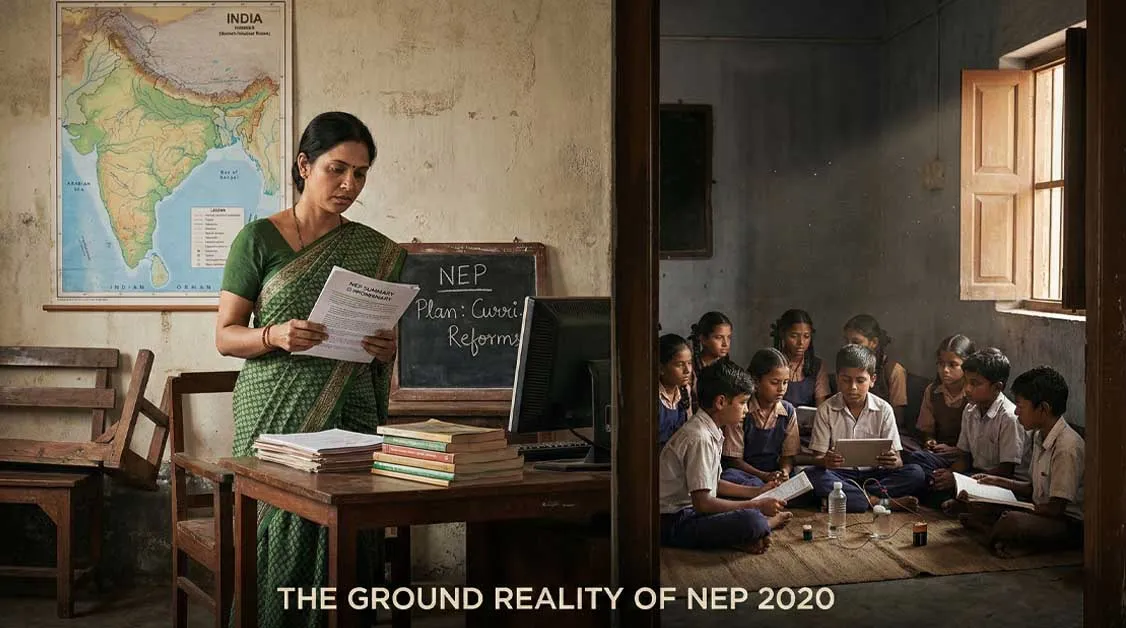
Since the Union Cabinet approved the National Education Policy (NEP) in 2020, millions of B.Ed degree holders and teaching aspirants have been caught in a storm of rumors. Every year, social media is flooded with claims of “massive overnight changes” in the recruitment rules for Trained Graduate Teachers (TGT) and Post Graduate Teachers (PGT). But what is the actual, verifiable ground reality in 2026?
If you are dedicating your days and nights to preparing for top-tier teaching exams like Kendriya Vidyalaya Sangathan (KVS), Navodaya Vidyalaya Samiti (NVS), DSSSB, or State Selection Boards like UP TGT/PGT, you can no longer rely on outdated 2018 notification rules. The landscape of government teaching jobs has fundamentally shifted.
The NEP 2020 proposed transitioning the school structure from the traditional 10+2 system to a 5+3+3+4 pedagogical structure. This single shift triggered a domino effect on how recruitment bodies evaluate a candidate’s minimum qualifications, subject combinations, and teaching skills. The days of simply memorizing a textbook, clearing a written exam, and securing a lifetime government job are over.
Today, the National Council for Teacher Education (NCTE) and various state boards have quietly implemented rigorous new filters. From mandatory classroom demonstrations to extended Teacher Eligibility Test (TET) requirements, the selection process is now designed to filter out rote learners and select dynamic educators. In this comprehensive, data-driven analysis, we will strip away the noise and break down the exact, documented changes in TGT and PGT recruitment rules that are actively impacting your job applications this year.
Quick Highlights: TGT/PGT Recruitment (Pre-NEP vs. 2026 Reality)
| Recruitment Aspect | Pre-NEP 2020 Rules | 2026 Ground Reality (Post-NEP) |
| TET Requirement | Mandatory only for PRT & TGT. | Expanding to PGT. (NCTE drafting Paper 3/Secondary TET). |
| Selection Process | Mostly Written Test (State boards). | Written + Demo Class + Interview (Mandatory in Central bodies). |
| B.Ed Degree | Standard 2-Year B.Ed accepted universally. | Push towards 4-Year ITEP; traditional B.Ed facing strict subject mapping. |
| Digital Literacy | Rarely tested. | CBT (Computer Based Test) mandatory; pedagogy questions include EdTech. |
| Subject Combinations | Flexible in many states. | Extremely rigid; Honors degree rules strictly enforced by DSSSB/KVS. |
The Expansion of TET: PGTs are No Longer Exempt
Historically, the Central Teacher Eligibility Test (CTET) or State TET was only a headache for Primary (PRT) and TGT aspirants. PGT candidates (Post Graduates) could directly apply for jobs based on their Master’s degree and B.Ed. That loophole is rapidly closing.
- The Secondary Stage Focus: Under the new 5+3+3+4 structure, classes 9 to 12 fall under a single “Secondary Stage.” To ensure quality across this entire bracket, the NCTE has laid the groundwork to make TET mandatory for PGTs.
- The Current Status: While not every state has implemented the “PGT TET” yet, central bodies are actively preparing for it. Aspirants targeting upcoming cycles should anticipate a CTET Paper 3 specifically designed for classes 9-12.
- TGT Subject Strictness: For TGTs, CTET Paper 2 is being scrutinized heavily. If you apply for TGT Science, your CTET Paper 2 must strictly be in Math/Science, not Social Studies.
Top 5 Free AI Tools to Cut Your CTET Preparation Time in Half
Introduction of the Multi-Stage Selection Process (Demo Classes)
Perhaps the biggest shock to the system post-NEP has been the restructuring of the actual exam phases. The policy explicitly states that a teacher’s merit cannot be judged solely by a multiple-choice OMR sheet.
- The KVS/NVS Blueprint: Kendriya Vidyalayas have already pioneered this change. The selection is no longer just Written + Interview. It is now divided into Written Test (CBT), Classroom Teaching Demo, and Personal Interview.
- Weightage Shift: The ratio of the written exam to the interview/demo has been adjusted (e.g., 70:30 in KVS). If you score brilliantly in the written test but fail to engage the panel during the 15-minute whiteboard demo, you will be rejected.
- State Boards Following Suit: State commissions (like the newly formed UP Education Service Selection Commission) are gradually updating their bylaws to include micro-teaching evaluations for TGT/PGT selections.
Expert Advice / Pro-Tip: Do not wait until you clear the written exam to practice your teaching skills. Buy a small whiteboard for your home. Practice delivering a 10-minute engaging lecture on your core subject (e.g., TGT Math: Pythagoras Theorem) twice a week. Communication skill is now a primary eligibility criterion, not a secondary one.
The B.Ed Evolution and the Rise of ITEP
If you are a fresher planning to enter the teaching profession, the type of degree you pursue matters more in 2026 than it did in 2018. The NEP envisions phasing out standalone teacher training institutes in favor of multidisciplinary colleges.
- Integrated Teacher Education Programme (ITEP): The government is heavily promoting the 4-year dual-major ITEP (B.A. B.Ed / B.Sc. B.Ed). Moving forward, candidates with ITEP degrees may receive preference or exclusive eligibility for specific foundational and preparatory stage vacancies.
- Subject Combination Rigidity: The “Subject Combination” trap is deadlier than ever. For example, to become a TGT Social Science teacher in DSSSB, having a generic B.A. is not enough. You must have studied History, Geography, Economics, or Political Science for at least two years at the graduation level.
- Post-Graduation Alignment: For PGTs, your Master’s degree must directly align with your B.Ed teaching subject. Cross-disciplinary applications (e.g., M.Sc in Biotechnology applying for PGT Biology) are facing massive rejections during document verification.
Digital Literacy and Modern Pedagogy
The modern government teacher cannot be a technophobe. The pandemic accelerated this, but NEP 2020 codified it into the recruitment rules.
- Computer-Based Tests (CBT): Almost all major TGT/PGT exams (DSSSB, EMRS, KVS) have permanently shifted from offline OMR sheets to online CBT mode.
- Upgraded Syllabus: The “Child Development and Pedagogy” (CDP) section has evolved. You are now tested on Experiential Learning, Competency-Based Education (CBE), and the use of digital platforms like DIKSHA and SWAYAM.
- NEP as a Syllabus Subject: NEP 2020 itself is now a dedicated 10-15 mark section in almost every teaching exam. You must know its clauses, structures, and foundational literacy goals by heart.
Conclusion: How to Navigate the 2026 Teaching Job Market
The ground reality of NEP 2020 is that government teaching jobs have become highly professionalized. The state is no longer looking for “job seekers”; they are looking for Subject Matter Experts (SMEs) who can command a classroom.
If you are a TGT or PGT aspirant, your immediate action plan should be to verify your subject combinations against the latest official DSSSB or KVS notifications. Secondly, upgrade your preparation strategy to include digital pedagogy and active teaching practice. Do not fear these changes; the filtering of non-serious candidates actually increases the selection chances for dedicated, well-prepared aspirants. Stay updated, adapt to the CBT environment, and treat your preparation as a professional training period.
Frequently Asked Questions (FAQs)
Is CTET mandatory for PGT recruitment in 2026?
Currently, CTET is strictly mandatory for PRT and TGT levels. However, as per NEP 2020 guidelines, the NCTE is actively working on introducing a TET for the secondary stage (Classes 9-12). Aspirants should be prepared for a PGT TET mandate in upcoming central government recruitment cycles.
Has the 2-year B.Ed degree become invalid?
No, the 2-year B.Ed degree is absolutely valid and recognized for current TGT and PGT recruitments. The NEP aims to make the 4-year ITEP the minimum degree qualification by 2030, but existing 2-year B.Ed holders will remain eligible and are not disqualified.
What is the new interview and demo class rule for TGTs?
Central recruitment bodies like KVS and NVS have made a classroom teaching demonstration and a personal interview a mandatory part of the selection process. This carries significant weightage (often up to 30% of the final merit), meaning written marks alone will not guarantee a job.
Can final year B.Ed students apply for TGT/PGT vacancies?
This depends entirely on the specific notification. Generally, official bodies like DSSSB and KVS require you to possess your final degree and your CTET certificate before the cutoff date mentioned in the job advertisement. Appearing candidates are usually not eligible.
How has the syllabus changed after NEP 2020?
While the core subject syllabus (e.g., Math, Physics, English) remains largely similar, the Pedagogy section has drastically changed. Exams now feature heavy weightage on Competency-Based Education, ICT (Information and Communication Technology) in classrooms, and specific clauses of the NEP 2020 document itself.

HS Patel is a seasoned expert with over 8 years of experience in the field of e.g., Education & Career Counseling. With a deep understanding of industry trends and user needs, he is dedicated to providing accurate, reliable, and high-quality content. His mission is to simplify complex information and empower readers with the right knowledge to succeed.