
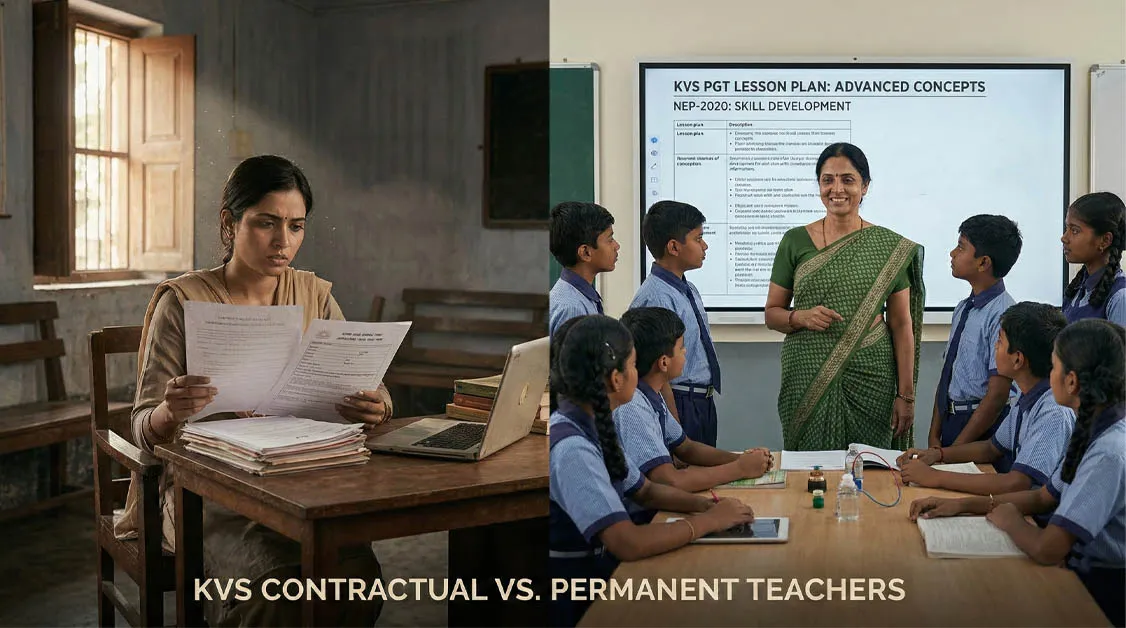
Every year, thousands of brilliant educators clear the Central Teacher Eligibility Test (CTET) with high hopes of joining the prestigious Kendriya Vidyalaya Sangathan (KVS). However, the harsh reality of 2026 is that permanent recruitment cycles are highly irregular, often leaving candidates waiting for years. In the meantime, KVS schools conduct walk-in interviews every February and March to hire thousands of ad-hoc or contractual teachers for the upcoming academic session.
This creates the ultimate dilemma for teaching aspirants: Should you take up a contractual KVS job, or should you stay home and prepare exclusively for permanent vacancies like DSSSB, NVS, or KVS direct recruitment? Many candidates blindly accept contractual roles thinking it is a “backdoor entry” to a permanent government job, which is a dangerous career myth.
To help you make a data-driven decision, we have mapped out the exact 10-year financial and career trajectory of a KVS Contractual Teacher versus a Permanent Teacher. This analysis breaks down the massive differences in salary, job security, allowances, and mental peace over a decade of service.
Quick Highlights: KVS Contractual vs. Permanent (2026 Snapshot)
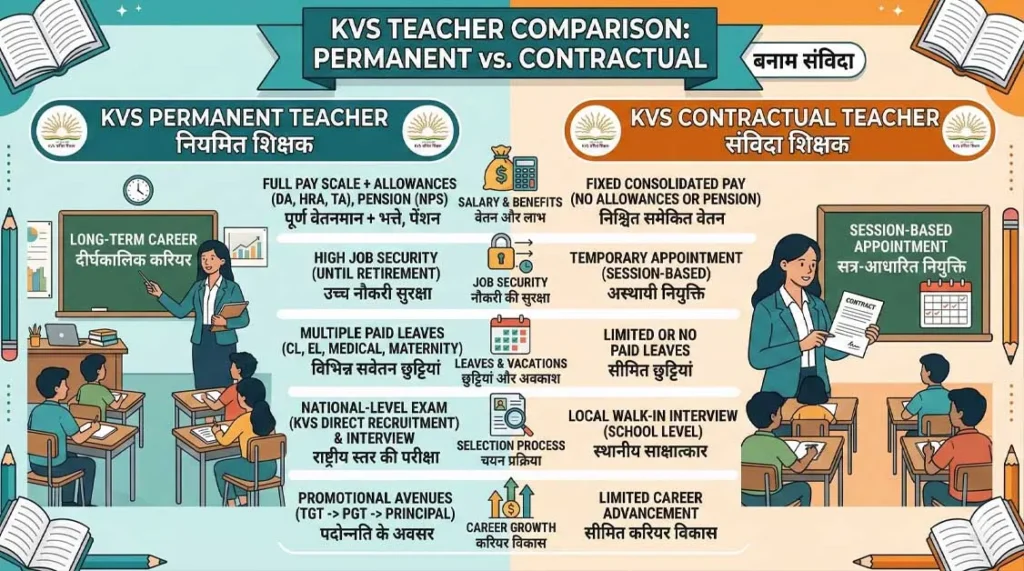
| Feature | KVS Contractual (Ad-Hoc) | KVS Permanent (Regular) |
| Hiring Process | Walk-in Interview (School Level) | National Exam (CBT) + Interview |
| Job Tenure | 11 Months (Max) | Up to Retirement (60 Years) |
| TGT Monthly Salary | ₹31,250 (Consolidated, Hard Station) | ₹75,000+ (Basic + DA + HRA) |
| Yearly Increments | None | 3% Annual Increment + DA Hikes |
| Paid Vacations | No (Unpaid during summer break) | Yes (Fully Paid) |
| Medical/Pension | No Benefits | CGHS Medical + NPS Pension |
The Financial Divide: A 10-Year Salary Trajectory
The most shocking difference between an ad-hoc and a regular teacher lies in wealth accumulation over time. The government pays contractual teachers a fixed consolidated monthly remuneration, which means there are no Dearness Allowance (DA) benefits to combat inflation.
- The Contractual Calculation: A contractual TGT earns roughly ₹31,250 per month. Because the contract lasts only 11 months (summer vacations are unpaid), the yearly earning is around ₹3.4 Lakhs. Over 10 years, assuming minor revisions in the consolidated pay policy, a contractual teacher will earn approximately ₹35 to ₹40 Lakhs.
- The Permanent Calculation: A permanent TGT starts at Level 7 of the 7th Pay Commission (Basic Pay ₹44,900). Adding 50%+ DA, HRA, and Transport Allowance in 2026, the starting gross salary easily crosses ₹75,000. With two DA hikes every year and a 3% annual increment, this salary crosses ₹1.2 Lakhs per month within a decade.
- The 10-Year Gap: Over 10 years, a permanent KVS TGT will comfortably earn over ₹1.2 Crores, along with accumulating lakhs in their National Pension System (NPS) account. The financial gap is a staggering ₹80 Lakhs.
Job Security and the “March Anxiety”
Mental peace is a heavily undervalued factor in the Indian job market. The psychological toll of an ad-hoc job can severely impact your teaching quality and personal life.
- The 11-Month Sword: Contractual teachers are hired for a maximum of 11 months, usually from April to March. Every year, your contract is terminated. You have no legal guarantee that the school principal will rehire you the following year.
- March Anxiety: While permanent teachers plan their summer vacations in March, contractual teachers are busy updating their resumes and appearing for walk-in interviews at different KVS branches just to secure their income for the next year.
- The Permanent Privilege: Once you clear your probation period as a regular KVS teacher, your job is completely secure until the age of 60. Dismissing a permanent government employee requires a lengthy, complex legal procedure.
Allowances, Leaves, and Hidden Benefits
Your salary slip is only half the story. The Indian government provides its permanent employees with an invisible safety net that contractual staff are completely denied.
- Health and Maternity: Permanent female teachers are entitled to 180 days of fully paid maternity leave and up to 2 years of Child Care Leave (CCL). Contractual teachers get zero paid maternity leave; taking a break means losing the job. Furthermore, permanent staff receive CGHS (Central Government Health Scheme) benefits for their entire family.
- Allowances: Permanent teachers receive House Rent Allowance (HRA), which is highly beneficial in Tier-1 cities. They also get Children Education Allowance (CEA) for their own kids. Contractual staff get absolutely none of these.
- Vacation Pay: Kendriya Vidyalayas have a 40-day summer break. Permanent teachers receive their full salary while sitting at home during this period. Contractual teachers are officially unemployed during May and June.
Does KVS Contractual Experience Help in Permanent Recruitment?
This is the biggest question asked by teaching aspirants. Many believe that working as an ad-hoc teacher will give them “extra marks” or a quota when permanent vacancies are announced.
- No Direct Quota: Let us be crystal clear: KVS does not provide any quota, bonus marks, or age relaxation to its contractual teachers during direct permanent recruitment. You will compete on the exact same computer-based test (CBT) as a fresh college graduate.
- The Interview Advantage: The only place your contractual experience helps is during the final interview phase of the permanent recruitment cycle. Panelists generally favor candidates who already understand KVS culture, assembly routines, and lesson planning formats.
- The Preparation Trap: Working 8 hours a day in a demanding KVS environment leaves very little energy to study for tough exams like DSSSB or UP TGT/PGT. Many brilliant candidates get trapped in the contractual cycle and fail to clear the permanent exams.
Expert Advice / Pro-Tip: If you are below 26 years of age and financially stable, do not join a KVS contractual post. Dedicate 100% of your time to preparing for permanent exams. Only opt for a contractual role if you desperately need the income to support your family or if you have already crossed the age limit for standard government exams.
Conclusion: Plan Your Next Move
Working as a KVS Contractual Teacher is an excellent way to gain professional experience, build confidence, and earn a respectable short-term income. However, it is not a long-term career. The 10-year financial disparity and the lack of basic employee rights make it unsustainable for a lifelong commitment.
If you are currently working as an ad-hoc teacher, your immediate goal should be to aggressively manage your time. Use your weekends and evenings strictly for self-study. Target upcoming permanent recruitment drives in Eklavya Model Residential Schools (EMRS), State Selection Boards, or the next KVS direct recruitment. Treat your contractual job purely as a temporary stepping stone, not your final destination.
Frequently Asked Questions (FAQs)
Can a KVS contractual teacher become permanent automatically?
No. There is no provision for the automatic regularization of contractual teachers in Kendriya Vidyalaya. To become permanent, you must wait for the official direct recruitment notification, apply online, and clear both the written exam and the interview alongside all other open-market candidates.
Is CTET mandatory for KVS contractual jobs in 2026?
Yes, CTET (Paper 1 for PRT and Paper 2 for TGT) is mandatory for appearing in KVS contractual interviews. However, some remote KVS branches occasionally relax this rule if they cannot find enough CTET-qualified candidates for a specific subject, but this is extremely rare.
Do KVS ad-hoc teachers get salaries during summer vacations?
No. Contractual teachers are hired for a maximum of 11 months or until a permanent teacher joins the post. Your contract is automatically terminated before the summer vacations, meaning you will not receive any salary for the break period (typically May and June).
What is the age limit for KVS contractual interviews?
The general age limit to apply for KVS contractual teaching posts (PRT, TGT, and PGT) is between 18 and 65 years. This wide age bracket makes it a popular option for retired teachers or individuals who have crossed the strict age limits of permanent government exams.

HS Patel is a seasoned expert with over 8 years of experience in the field of e.g., Education & Career Counseling. With a deep understanding of industry trends and user needs, he is dedicated to providing accurate, reliable, and high-quality content. His mission is to simplify complex information and empower readers with the right knowledge to succeed.