
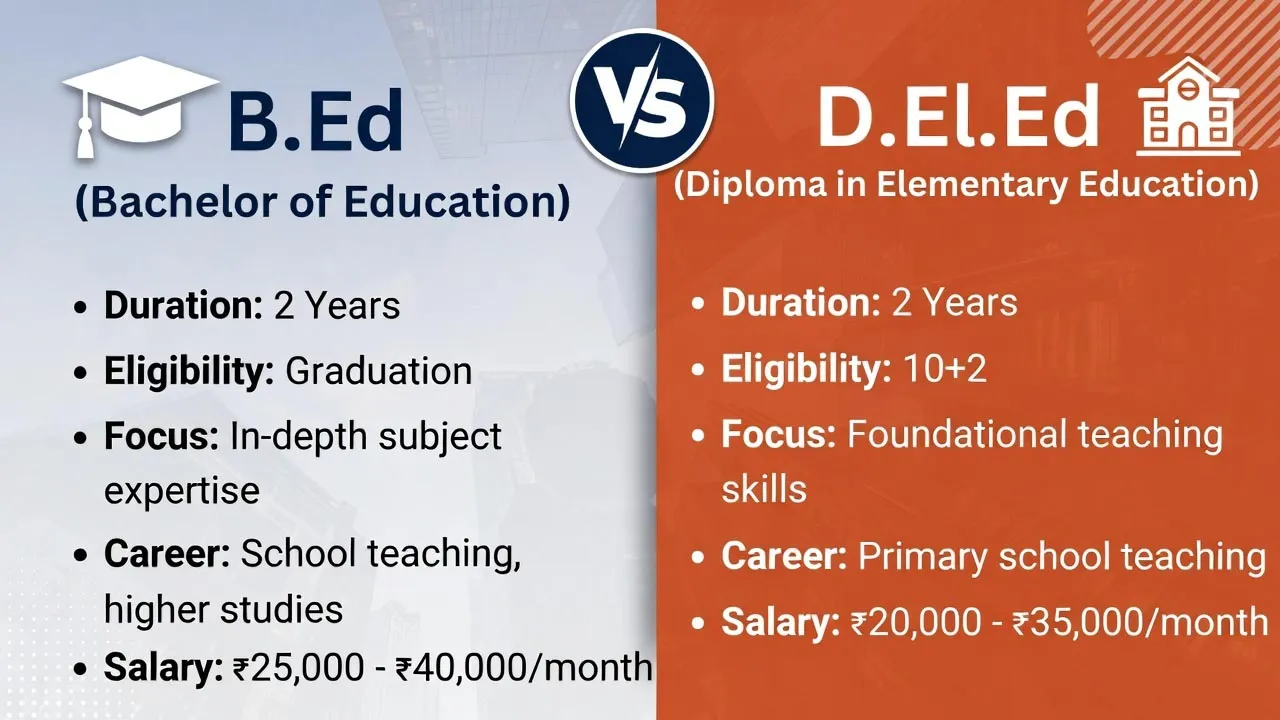
For years, Indian teaching aspirants believed a simple myth: “Do a B.Ed, and you can apply for any teaching job from Class 1 to Class 12.” If you are planning your teaching career in 2026 based on this outdated advice, you are walking straight into a career trap.
The landscape of government teaching jobs underwent a massive earthquake recently following the Hon’ble Supreme Court of India’s landmark judgment. The rules for becoming a Primary Teacher (PRT) have completely changed, drawing a hard, legal line between the Bachelor of Education (B.Ed) and the Diploma in Elementary Education (D.El.Ed).
Today, choosing the wrong course doesn’t just delay your career; it legally disqualifies you from applying for thousands of upcoming vacancies in KVS, DSSSB, and State Education Boards. If your primary goal is to secure a stable “Sarkari Naukri” as quickly as possible, you need to understand the 2026 ground reality of vacancy volumes, eligibility criteria, and salary structures. Let us break down exactly which course will fast-track your journey to becoming a government teacher.
Quick Highlights B.Ed vs. D.El.Ed 2026
| Feature | D.El.Ed (Diploma in Elementary Education) | B.Ed (Bachelor of Education) |
| Eligible Teaching Level | Primary (Classes 1 to 5) | Upper Primary, TGT & PGT (Classes 6 to 12) |
| Minimum Qualification | 12th Pass (in most states) or Graduation | Graduation (Minimum 50% marks) |
| CTET Requirement | CTET Paper 1 | CTET Paper 2 |
| PRT Eligibility (2026) | 100% Eligible (Exclusive rights) | Legally Not Eligible |
| Starting Basic Pay (7th CPC) | ₹35,400 (Level 6) | ₹44,900 (Level 7) to ₹47,600 (Level 8) |
The Supreme Court Verdict The Ultimate Game Changer
To understand the 2026 job market, you must understand the legal reality. Previously, B.Ed candidates were allowed to apply for Primary Teacher (PRT) posts on the condition that they would complete a 6-month bridge course after joining.
This changed permanently when the Supreme Court ruled that B.Ed degree holders are ineligible for PRT posts. The court clearly stated that teaching primary students requires specialized pedagogical training focusing on child psychology and foundational learning, which is explicitly covered in the D.El.Ed curriculum, not B.Ed.
As a result, organizations like Kendriya Vidyalaya Sangathan (KVS), Navodaya Vidyalaya Samiti (NVS), and state boards immediately modified their recruitment rules. In 2026, D.El.Ed holds an absolute monopoly over PRT vacancies.
D.El.Ed: The Fast-Track to a Secure Sarkari Naukri
If your only goal is to secure a government job as fast as possible, D.El.Ed (also known as BTC or JBT in some states) is arguably the safest bet.
- Massive Vacancy Volumes: Governments prioritize foundational literacy. When a state like Uttar Pradesh (Super TET), Bihar (BPSC TRE), or Rajasthan (REET) releases teaching vacancies, the PRT posts (Classes 1-5) almost always outnumber TGT/PGT posts by a massive margin.
- Less Complex Syllabus: To secure a PRT job, you need to clear CTET Paper 1 and the respective recruitment exam. The syllabus focuses on elementary math, basic EVS, and Child Development & Pedagogy (CDP). It is generally less intense than mastering postgraduate-level subjects required for PGT roles.
- No Subject Combination Hassles: A PRT is a generalist teacher. You do not have to worry about whether your B.A. or B.Sc. subjects align perfectly with the school’s specific requirements.
B.Ed: The Gateway to Higher Salaries and Prestige
While D.El.Ed offers a faster entry, the Bachelor of Education (B.Ed) offers immense long-term career growth, higher prestige, and a significantly better salary structure.
- Targeting TGT and PGT: B.Ed makes you eligible for Trained Graduate Teacher (TGT – Classes 6 to 10) and, combined with a Master’s degree, Post Graduate Teacher (PGT – Classes 11 to 12) roles.
- The Financial Advantage: A PRT starts at Level 6 of the 7th Pay Commission. A TGT starts at Level 7, and a PGT at Level 8. Over a 10-year career, this translates to a massive difference in your gross salary, DA, and pension accumulation.
- Subject Matter Expertise: If you are deeply passionate about a specific subject—say, Physics, History, or English—B.Ed allows you to build a career around your expertise rather than teaching basic alphabet and numbers.
The Hidden Trap in B.Ed: Subject Combinations
If you decide to pursue a B.Ed, you must be extremely cautious about a technicality that ruins thousands of careers every year: Subject Combinations.
Unlike D.El.Ed, B.Ed recruitment is highly specific. If you apply for a TGT Social Science post in DSSSB, having a generic B.A. degree is not enough. The official rules mandate that you must have studied at least two specific subjects (like History, Geography, Economics, or Political Science) during your graduation.
Expert Advice / Pro-Tip: Before taking admission into a B.Ed program in 2026, download the latest recruitment notification for KVS or DSSSB. Cross-check your graduation mark sheets with their “Essential Qualifications” section. If your B.A./B.Sc. subjects do not match their strict combinations, your B.Ed degree will be useless for government jobs, and you will be rejected during document verification.
Which Course Guarantees a “Faster” Job in 2026?
The answer depends entirely on your current educational profile and career patience.
If we look purely at statistics and probability, D.El.Ed offers a faster route to employment. Because D.El.Ed candidates have exclusive rights to PRT jobs, and PRT vacancies are released in large bulk numbers (often in the tens of thousands by state governments), your mathematical chances of selection are much higher.
However, if you already possess a strong academic background, have completed your Master’s degree, and are willing to compete in high-stakes, subject-specific exams, B.Ed is the superior choice for long-term financial growth.
Conclusion: Make Your Choice Wisely
The era of “one degree fits all” in Indian education is over. The recruitment rules in 2026 demand absolute clarity from aspirants.
If your priority is early financial independence, zero subject-combination headaches, and you enjoy working with young children, enroll in D.El.Ed and immediately start preparing for CTET Paper 1. Conversely, if you want a higher pay scale, wish to teach advanced subjects, and possess the correct graduation subject mapping, B.Ed is your clear path forward. Stop listening to outdated neighborhood advice—align your degree with the current legal framework of government recruitment and start your preparation today.
Frequently Asked Questions (FAQs)
Can a B.Ed candidate apply for KVS PRT in 2026?
No. Following the Supreme Court of India’s judgment, B.Ed degree holders are legally disqualified from applying for Primary Teacher (PRT) positions in KVS, NVS, or any state government schools. Only D.El.Ed/BTC candidates are eligible for Classes 1 to 5.
Which CTET paper is required for D.El.Ed candidates?
D.El.Ed candidates who wish to teach primary classes (1 to 5) must successfully clear CTET Paper 1. If a D.El.Ed candidate also holds a graduation degree, they can sometimes apply for upper primary posts by clearing CTET Paper 2, depending on state-specific rules.
Does B.Ed offer a better salary than D.El.Ed?
Yes, generally speaking. B.Ed candidates apply for TGT and PGT posts, which fall under Level 7 and Level 8 of the 7th Pay Commission, respectively. D.El.Ed candidates apply for PRT posts, which fall under Level 6. Therefore, B.Ed-related jobs have a higher starting basic pay.
Is D.El.Ed considered a graduation degree?
No, D.El.Ed stands for Diploma in Elementary Education. It is a 2-year diploma course, not a bachelor’s degree. To apply for higher-level exams (like UPSC or SSC CGL), you will still need a proper undergraduate degree (B.A., B.Sc., B.Com) alongside your diploma.

HS Patel is a seasoned expert with over 8 years of experience in the field of e.g., Education & Career Counseling. With a deep understanding of industry trends and user needs, he is dedicated to providing accurate, reliable, and high-quality content. His mission is to simplify complex information and empower readers with the right knowledge to succeed.