
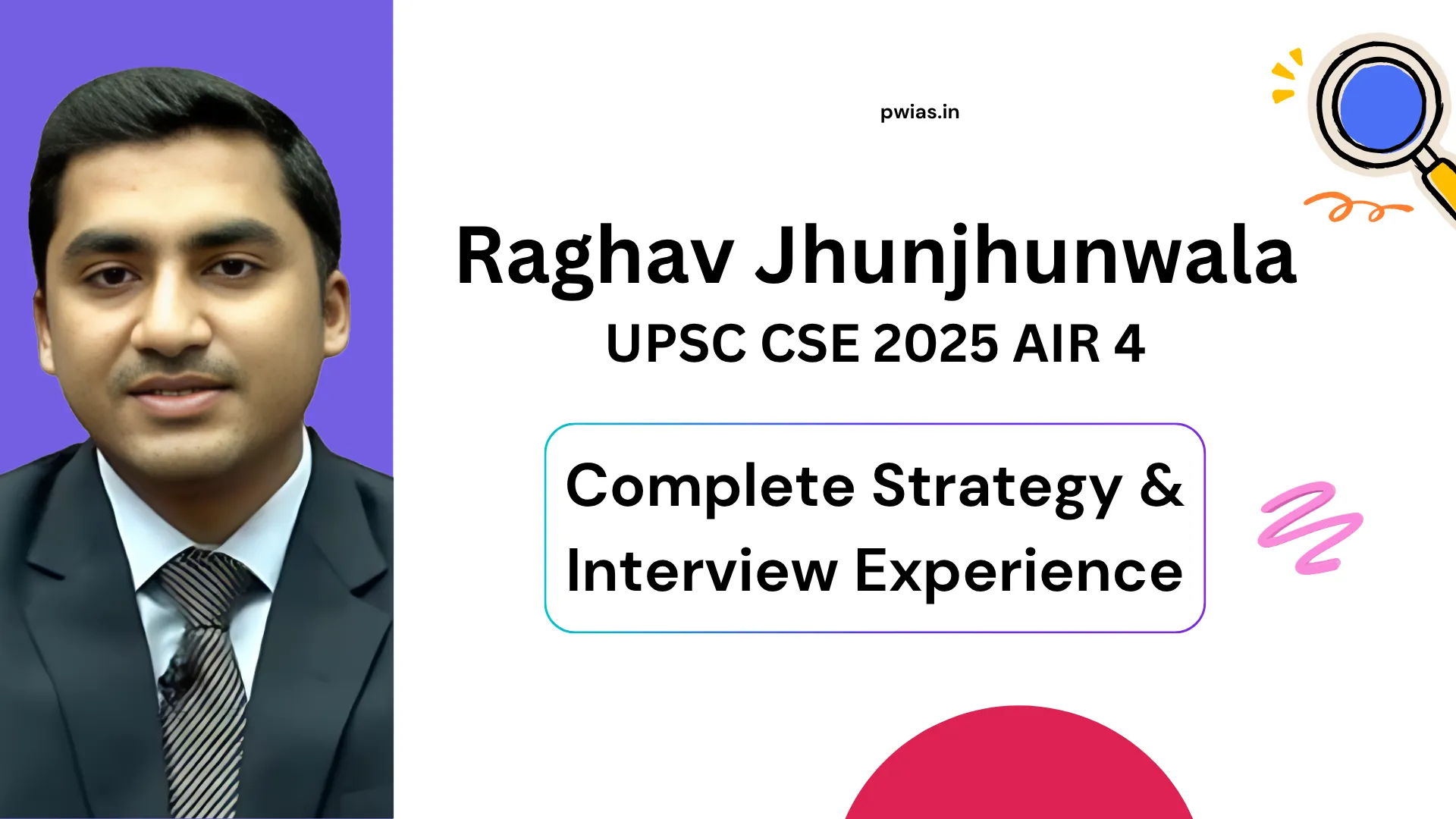
The Union Public Service Commission (UPSC) Civil Services Examination is an unparalleled marathon. Every year, nearly a million aspirants compete for fewer than a thousand coveted spots. When the final results for the 2025 cycle were declared, the nation witnessed a brilliant mind claim All India Rank (AIR) 4 Raghav Jhunjhunwala.
Securing a single-digit rank in this extraordinarily competitive exam demands more than just hard work; it requires clinical precision, unwavering discipline, and a bulletproof strategy. Congratulations are pouring in for Raghav, but future candidates are looking for the blueprint behind this victory. If you are preparing for the upcoming attempts, this article is your ultimate guide. We break down Raghav’s daily study routine, his definitive booklist, and the exact questions he faced inside the legendary Dholpur House interview room.
The Success Story & Strategy of Raghav Jhunjhunwala
Background & Journey: The Chartered Accountant’s Pivot
Hailing from Kolkata, West Bengal, Raghav Jhunjhunwala always exhibited a razor-sharp analytical mind. He completed his B.Com (Honours) from St. Xavier’s College, Kolkata, and concurrently cleared his Chartered Accountancy (CA) exams with a stellar rank.
While the corporate world offered lucrative investment banking and auditing roles, Raghav’s sights were set on public administration. He recognized that the complex financial framework of modern India requires administrators who deeply understand economics, taxation, and corporate governance. This was his second attempt. In his first attempt, he faltered at the Mains stage, which taught him the crucial difference between merely knowing the syllabus and presenting it effectively on paper.
Preparation Strategy & Daily Routine
Raghav’s approach was famously pragmatic. He treated UPSC preparation like a rigorous corporate audit—leaving no loopholes and adhering to strict deadlines.
- The 10-Hour Rule: Raghav maintained a consistent study schedule of 10 to 11 hours daily. He divided his day into three massive blocks: foundational static subjects in the morning, optional subject after lunch, and current affairs in the evening.
- Commerce & Accountancy Optional: Leveraging his CA background, he opted for Commerce & Accountancy. This strategic choice drastically reduced his preparation time for the optional, allowing him to dedicate more hours to General Studies and Essay writing.
- Mock Test Cycle: He was relentless with practice. Before Prelims, Raghav solved over 50 mock tests, focusing heavily on the post-test analysis to understand his negative marking patterns. For Mains, he completed 15 full-length sectional and comprehensive tests, ensuring he could finish the 20-question papers within the strict 3-hour limit.
- Sunday Revisions: He kept his Sundays strictly for revision. No new material was touched. He relied on active recall, utilizing short, handwritten mind maps to revise entire subjects in a few hours.
Recommended Books & Study Material
To build a solid foundation, Raghav stuck to the standard resources but revised them multiple times. Here is his trusted booklist for the written stages:
- Indian Polity: Indian Polity by M. Laxmikanth (Read end-to-end at least 8 times).
- Modern History: A Brief History of Modern India by Spectrum.
- Geography: NCERTs (Class 11 & 12) and G.C. Leong.
- Economy: Mrunal Patel’s handouts combined with the Economic Survey and Union Budget.
- Environment: Shankar IAS notes supplemented heavily by current affairs.
- Current Affairs: Daily reading of The Indian Express (focusing on the Explained section) and monthly compilations from Vision IAS.
The Interview Experience / Personality Test
The UPSC Personality Test is where your character is tested under pressure. For Raghav, this stage was the ultimate game-changer that pushed him into the Top 5.
The Panel & Atmosphere
Raghav’s interview was held at the UPSC headquarters in New Delhi. He faced a highly experienced board chaired by a former central bureaucrat. The atmosphere was cordial, professional, and intellectually stimulating. The panel did not try to intimidate him; rather, they tested the depth of his convictions and his ability to hold a logical debate without losing his composure.
Types of Questions Asked
Because of his specialized background, Raghav’s interview heavily revolved around economics, state governance, and ethical scenarios.
- DAF (Personal Background): “You are a qualified Chartered Accountant. Why do you want to leave a specialized, high-paying career to become a generalist administrator? Aren’t you wasting the state’s educational resources?”
- Subject-Specific (Economy): “India is experiencing robust GDP growth, yet we hear frequent discussions about ‘jobless growth’. As an economist, how do you explain this paradox, and how can the government fix it?”
- Situational & Ethical: “You are posted as a District Magistrate in a highly industrialized district. A major factory, which employs 5,000 local youth, is found to be illegally discharging untreated chemical waste into the river, violating environmental norms. Shutting it down will cause massive unemployment and unrest. How will you handle this?”
- Current Affairs: Questions were also asked regarding the global push for a Minimum Corporate Tax and its implications on developing economies like India.
The Winning Approach
Raghav’s success stemmed from his structural thinking. When answering the situational question about the factory, he didn’t give a generic response. He outlined a phased approach: issuing a show-cause notice, imposing heavy financial penalties to fund immediate river cleanup, and giving the management a strict, monitored deadline to install a Zero Liquid Discharge (ZLD) system, ensuring both the environment and jobs were protected.
When asked about complex geopolitical treaties he wasn’t fully aware of, Raghav smiled and politely said, “I am afraid I do not have the exact details on this treaty, sir, but I will definitely read up on it.” This intellectual honesty is highly rewarded by the UPSC board.
Result Analysis & Competition
The 2025 iteration of the UPSC CSE maintained its reputation for unpredictability. Out of approximately 10 lakh applicants, only around 958 candidates made it to the final merit list.
- Cut-off Trends: The Prelims cut-off is expected to be in the range of 92-95 marks for the General category, reflecting a highly conceptual General Studies paper and a notoriously difficult CSAT paper.
- Mains Scoring: Candidates who integrated current affairs seamlessly into their static answers scored the highest. Raghav’s final tally is expected to be well above the 1050-mark threshold, highlighting his dominance in both the written and interview stages.
Roadmap for Future Aspirants
If you are starting from scratch and aiming for the upcoming UPSC attempts, follow these four actionable steps inspired by AIR 4:
- Conquer the CSAT Early: Do not underestimate the CSAT paper. Dedicate at least one hour a day to reading comprehension and logical reasoning, starting six months before Prelims.
- Master Your Optional: Your optional subject is the biggest rank decider. Aim to complete your optional syllabus and at least 5 years of Previous Year Questions (PYQs) before the Prelims cycle begins.
- Active Newspaper Reading: Passive reading is useless. Extract data points, supreme court judgments, and committee recommendations from the newspaper and use them directly in your daily answer writing practice.
- Build Emotional Resilience: The UPSC journey is mentally taxing. Treat failures in mock tests as data points for improvement, not as judgments of your capability. Consistency will always beat sheer intellect.
Frequently Asked Questions (FAQs)
Q1. Who is Raghav Jhunjhunwala?
Raghav Jhunjhunwala is the All India Rank (AIR) 4 holder in the UPSC Civil Services Examination 2025. He is a Chartered Accountant and a B.Com graduate from Kolkata.
Q2. Which optional subject did Raghav Jhunjhunwala choose?
He chose Commerce & Accountancy as his optional subject, utilizing his academic background to maximize his scores.
Q3. Did the UPSC topper take any coaching?
Raghav primarily relied on extensive self-study and standard books. However, he enrolled in specific test series for Mains answer writing evaluation and took mock interviews to polish his personality test skills.
Q4. What was the most challenging part of Raghav’s interview?
Defending his transition from a highly specialized CA career to a generalist civil service role was a recurring theme, requiring him to present a clear, value-driven justification.
Q5. How many hours did AIR 4 study daily?
Raghav maintained a disciplined routine of 10 to 11 hours of focused study every day, proving that consistency is the ultimate key to cracking the UPSC CSE.

HS Patel is a seasoned expert with over 8 years of experience in the field of e.g., Education & Career Counseling. With a deep understanding of industry trends and user needs, he is dedicated to providing accurate, reliable, and high-quality content. His mission is to simplify complex information and empower readers with the right knowledge to succeed.