
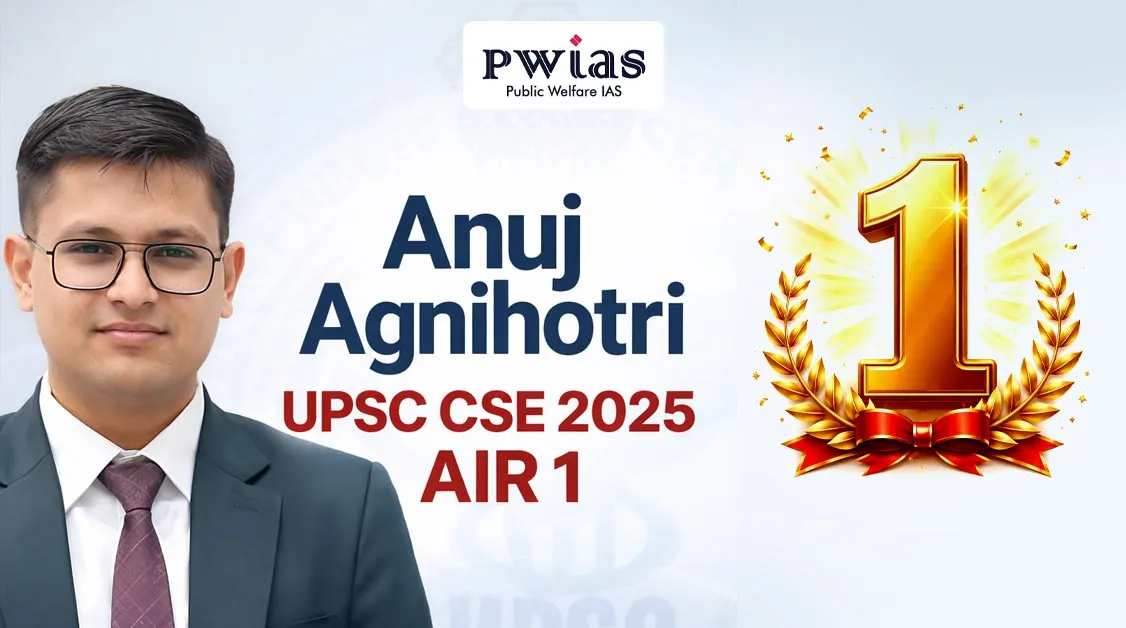
On March 6, 2026, the Union Public Service Commission (UPSC) announced the final results for the Civil Services Examination 2025, sending waves of inspiration across the country. Topping the list of 958 successful candidates is Anuj Agnihotri, a 26-year-old medical graduate who secured All India Rank (AIR) 1. His journey from the wards of AIIMS Jodhpur to the corridors of power is a masterclass in resilience, strategic planning, and intellectual depth.
The UPSC CSE is notorious for its grueling three-stage process, where over 9 lakh applicants compete for a few hundred seats. This year, the competition reached new heights with shifting question patterns in Prelims and a highly analytical Mains stage. In this comprehensive guide, we break down Anuj’s “no-coaching” self-study model and his unique interview journey. Future aspirants will find a detailed roadmap here to navigate both the written papers and the daunting personality test.
The Success Story & Strategy of Anuj Agnihotri (AIR 1)
Background & Journey: From AIIMS Jodhpur to the Top of UPSC
Anuj Agnihotri hails from Rawatbhata in Chittorgarh, Rajasthan, and his academic record has always been stellar. He completed his MBBS from AIIMS Jodhpur in 2023. While most medical graduates look toward clinical specialization, Anuj felt a calling for broader societal impact. He realized that while a doctor saves lives individually, an administrator can reform entire healthcare systems.
This was Anuj’s third attempt at the Civil Services. His persistence is evident in the fact that he was already serving as a DANICS (Delhi, Andaman and Nicobar Islands Civil Service) probationer and an SDM in Delhi when the 2025 results were announced. Balancing the responsibilities of a civil servant with the preparation for AIR 1 is a feat that highlights his extraordinary time management skills.
Preparation Strategy & Daily Routine
Anuj Agnihotri’s preparation was rooted in a “Zero-Coaching” philosophy. He relied entirely on self-study, proving that quality resources are now accessible to everyone through digital platforms and standard textbooks.
- 13-Hour Workday: Anuj treated his preparation like a full-time job, often clocking 13 hours of study daily. Even during his medical internship and later during his DANICS training, he carved out dedicated slots for revision.
- Integrated Approach: He did not separate Prelims and Mains. Instead, he focused on building “conceptual anchors.” For instance, while studying the “Governor’s Role” in Polity, he prepared the factual data for Prelims and the critical analysis for Mains simultaneously.
- Medical Science Optional: Leveraging his MBBS background, Anuj chose Medical Science as his optional subject. This allowed him to maintain a high scoring potential in a subject he already mastered during his five years at AIIMS.
- The Power of Mock Tests: Anuj utilized mock tests not just for practice but as a diagnostic tool. After every 2-hour test, he spent at least 3 hours analyzing his mistakes and refining his elimination techniques.
Recommended Books & Study Material
To clear the written stages of UPSC CSE 2025, Anuj followed a minimalist yet intensive booklist. He emphasizes the rule: “Read one book ten times, not ten books one time.”
- Indian Polity: M. Laxmikanth (Essential for both stages).
- Modern History: A Brief History of Modern India by Spectrum (Rajiv Ahir).
- Geography: NCERTs (Class 11 & 12) and G.C. Leong for physical geography.
- Economy: Mrunal Patel’s notes or Vikas Bahl for conceptual clarity on macroeconomics.
- Environment: Shankar IAS notes supplemented by current updates from Down To Earth.
- Current Affairs: Daily reading of The Hindu and monthly value-addition from magazines like Vision IAS or PT 365.
The Interview Experience / Personality Test
The UPSC interview is not a test of knowledge—that has already been tested in the Mains. It is a Personality Test designed to assess a candidate’s mental alertness, critical powers of assimilation, and leadership potential.
The Panel & Atmosphere
Anuj’s interview took place at Dholpur House, New Delhi. He described the atmosphere as formal yet cordial. The board, chaired by a senior UPSC member, aimed to have a purposeful conversation rather than a rapid-fire interrogation. The goal was to see how Anuj handled pressure and whether he could maintain a balanced perspective under scrutiny.
Types of Questions Asked
Anuj faced a diverse set of questions that spanned his professional background, his native state, and global ethics.
- The Transition Question (Doctor to IAS): The chairman opened with a brilliant metaphor: “Since you are a doctor entering civil administration, what kind of surgery would you perform as a civil servant, and what would be your instruments?” Anuj replied that he would perform “systemic surgery” to remove the “cancer of corruption and inefficiency,” using transparency and technology as his scalpels.
- DAF & Background: Coming from the Mewar region of Rajasthan, he was asked about Mirabai and the Bhakti movement’s impact on modern society. He also discussed the historical contributions of Colonel James Tod to Rajasthan’s historiography.
- Situational/Policy Questions: As a doctor, he was asked: “If you were a DM, what one health intervention would you implement?” Anuj proposed mandatory annual health check-ups for citizens above 40 to catch Non-Communicable Diseases (NCDs) like diabetes and hypertension early.
- Analytical Current Affairs: The panel discussed India’s Total Fertility Rate (TFR) falling below replacement level and the challenges of an aging population in states like Kerala and Tamil Nadu.
The Winning Approach
Anuj’s success in the interview came from his honesty. When asked a question about a complex nuclear power project at NPCIL (where his father works), he maintained a balanced view, acknowledging both the energy needs and environmental concerns. His ability to say “I don’t know” gracefully when faced with obscure factual questions showed his integrity—a trait the UPSC board highly values.
Result Analysis & Competition
The 2025 cycle saw 9,37,876 candidates apply, out of which 5,76,793 actually appeared for the Prelims on May 25, 2025. This shows a staggering 1:1000 success ratio.
- Cut-off Trends: The General category cut-off for Prelims was 92.66, reflecting a paper that was tougher and more analytical than previous years.
- Final Marks: To secure a recommendation, a General category candidate needed a final aggregate of 963 marks (Written + Interview).
- Vacancy Stats: Out of 1,087 vacancies, the commission recommended 958 candidates in the first list. This highlights the high standards maintained by the UPSC; they will not fill seats unless candidates meet the “benchmark of excellence.”
Roadmap for Future Aspirants
If you are aiming for UPSC 2026 or 2027, follow these four actionable steps inspired by Anuj Agnihotri’s AIR 1 journey:
- Build a Base with NCERTs: Spend the first 4 months exclusively on NCERTs (Class 6-12). Without a strong foundation, advanced books like Laxmikanth will feel like a burden.
- Master Your Optional Early: Finish at least 70% of your optional syllabus before you appear for your first Prelims. This reduces the immense pressure during the 3-month gap between Prelims and Mains.
- Active Newspaper Reading: Don’t just read the news; analyze it. Ask “Why is this happening?” and “How does this affect India’s internal security or economy?”
- Prioritize Mental Health: Anuj’s story proves that perseverance is key. Motivation fluctuates, but discipline stays. Find a hobby—like Anuj’s interest in Rajasthan’s local history—to de-stress during the long preparation cycle.
Frequently Asked Questions (FAQs)
Q1. What was Anuj Agnihotri’s optional subject?
Anuj chose Medical Science as his optional subject, leveraging his MBBS degree from AIIMS Jodhpur.
Q2. Did the UPSC 2025 topper take coaching?
No, Anuj Agnihotri is a proponent of self-study. He utilized online resources and standard textbooks but did not enroll in traditional full-time coaching institutes.
Q3. How many attempts did it take for Anuj to get AIR 1?
Anuj secured AIR 1 in his third attempt. He had previously cleared the exam and was already serving in the DANICS cadre.
Q4. What were the interview questions for Anuj Agnihotri?
Key questions included his transition from medicine to IAS, the history of Mewar, India’s declining fertility rates, and infrastructure projects in Great Nicobar.
Q5. What was the UPSC Prelims 2025 cut-off for the General category?
The official cut-off for the General category in Prelims 2025 was 92.66 marks.

I am Reena Sharma, a dedicated educator and mentor at PWIAS (Public Welfare IAS), where my mission is to simplify the journey to the civil services for aspirants across India. With a deep-rooted passion for public service and academic excellence, I specialize in crafting high-impact educational content and strategic roadmaps for UPSC and State PSC candidates.