
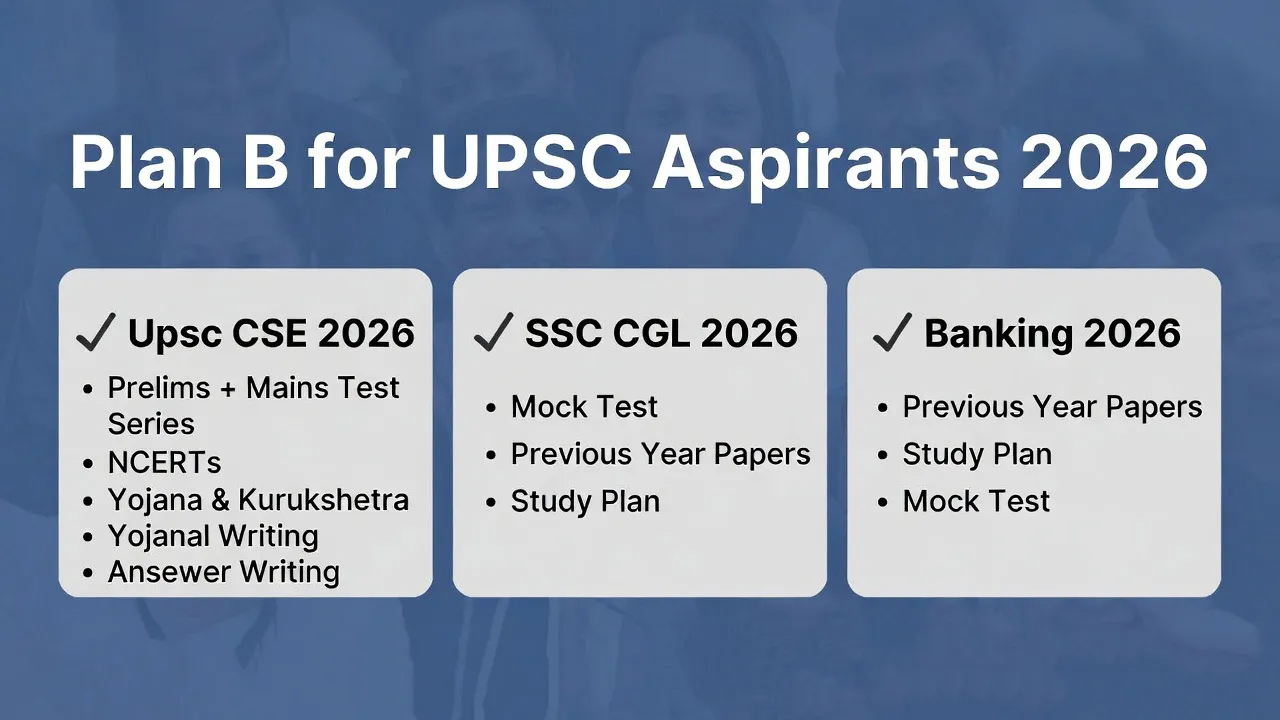
The UPSC Civil Services Examination (CSE) remains the most prestigious pursuit in India, but the 2026 reality is stark: with over 13 lakh aspirants competing for roughly 1,000 seats, the success rate is less than 0.1%. For years, the narrative was “IAS or nothing,” but in 2026, the corporate and policy landscape has evolved to value the “Aspirant Skillset” more than ever. If you have spent 2-3 years mastering Indian Polity, International Relations, and Ethics, you aren’t just a “student”—you are a high-potential analyst.
The significance of a solid “Plan B” has shifted from being a safety net to a strategic career pivot. Leading global consultancies (McKinsey, BCG, Bain) and Indian think tanks are now actively headhunting ex-aspirants for roles in Public Policy, ESG Risk, and Corporate Intelligence. The competition in 2026 is no longer about who memorizes the most; it’s about who can apply GS-II (Governance) and GS-III (Economy) logic to the private sector. This guide analyzes how you can leverage your UPSC preparation to secure roles paying between ₹12 LPA to ₹35 LPA without starting from zero.
Quick Highlights: Top Plan B Roles 2026
| Career Path | Primary Overlap | Avg. Starting Salary | Top Recruiters | Official Reference |
| Public Policy Analyst | GS-II, GS-III, Current Affairs | ₹12 – ₹18 LPA | NITI Aayog, ORF, QCI | niti.gov.in |
| ESG & Sustainability | GS-III (Env), Ethics (GS-IV) | ₹15 – ₹25 LPA | EY, KPMG, Tata Power | mca.gov.in |
| Corporate Intelligence | GS-II (Security), IR | ₹18 – ₹30 LPA | Control Risks, Deloitte | Industry Benchmark |
| Management Consulting | Ethics, CSAT, Economy | ₹20 – ₹35 LPA | MBB (McKinsey, BCG) | Corporate Trend |
Important Pivot Timelines & Market Schedule
Candidates often wait until they are 30 to look for a Plan B. In 2026, the “Golden Window” for a pivot is immediately after your 2nd or 3rd Mains attempt.
- Hiring Peak (Policy/Consulting): January to March (Post-Mains result).
- Fellowship Deadlines: Most high-value fellowships (CMGGA, LAMP, MGNF) close applications by April-May.
- Why wait? Server issues aren’t the problem here; the “Market Gap” is. Delaying your pivot by even one year can result in a 20% lower starting CTC due to “career gaps.”
UPSC Notification 2026 PDF Apply Online for 933 Posts
Eligibility Criteria (The Technical Deep-Dive)
The private sector doesn’t ask for a “Preliminary Qualifiers” certificate, but they do require specific proxies for your UPSC knowledge.
- Educational Qualification: Most Policy/Consulting roles require a Master’s in Economics, Political Science, or an MBA. However, 2026 trends show that a B.Tech + 2 UPSC Mains is considered equivalent to a specialized degree by many firms.
- UPSC Milestone Proof: Companies now explicitly ask for Mains Admit Cards or Interview Call Letters as proof of “Advanced Knowledge.”
- The Age Limit Factor: Unlike the strict 32-year cap in UPSC, the private sector values experience. However, entering as an “Associate” is easiest before age 28.
Salary Structure & 7th Pay Commission Comparison
One of the biggest hooks for the 2026 “Plan B” is the financial reward. While an entry-level IAS officer (Level 10) earns a gross of roughly ₹1 Lakh/month, private policy roles often exceed this.
- NITI Aayog Flexi-Pool (Contractual): As per the March 2026 Circular, “Associates” receive a consolidated pay of ₹1,05,000, while “Specialists” (with 8 years experience) get ₹1.45 Lakh to ₹2.2 Lakh/month.
- Private ESG Roles: Due to strict SEBI mandates on sustainability reporting, ESG specialists with GS-III (Environment) expertise are commanding salaries of ₹18 LPA+ in Tier-1 cities.
Syllabus Overlap (The “Helpful” Guide)
- GS-II (Polity & Governance): Direct application in Regulatory Affairs and Government Relations. You understand how laws are made, which is invaluable for MNCs navigating Indian regulations.
- GS-III (Economy & Env): The backbone of ESG Consulting. Carbon credits, green bonds, and fiscal policy are now boardroom discussions.
- GS-IV (Ethics): The core of Corporate Governance and Compliance. Ethical dilemmas in administration are identical to those in high-stakes business.
How to Apply & Transition (Step-by-Step)
- Visit LinkedIn: Search for “Public Policy,” “ESG,” or “Advisory” roles.
- Translate your CV: Replace “UPSC Aspirant” with “Policy & Research Specialist.”
- Highlight Milestones: Mention “Qualified for UPSC Mains (Top 1% of 10 Lakh candidates).”
- Upskill: Take a 4-week certification in Data Visualization (Tableau/PowerBI) or ESG Frameworks.
- Network: Connect with “Ex-Aspirants” currently working in Big4 firms.
- Apply via Referrals: In the private sector, referrals are your “Admit Card.”
- Print your Portfolio: Prepare a 2-page summary of your “Optional Subject” expertise and its business application.
Pro-Tip: Keep your LinkedIn profile updated with “Current Affairs Analysis” posts. It acts as a digital portfolio for your analytical skills.
Detailed Strategy & Expert Insights
To clear the transition in your “first attempt,” you must stop thinking like a student and start thinking like a consultant. Our analysis of the 2025-26 Hiring Trends shows that firms are tired of generic MBA resumes; they want the “Depth” of a UPSC aspirant.
- How to clear the Interview: Focus on “Data-backed storytelling.” If asked about the economy, don’t just quote the Economic Survey; explain how the PLI Scheme affects the specific company’s supply chain.
- The “IAS” Advantage: Your ability to sit for 10 hours and synthesize 500 pages of data into a 10-page brief is your “Superpower.” Market this as “Strategic Research Capability.”
Frequently Asked Questions (FAQ)
Q1: Can I get a job if I only cleared Prelims?
A: Yes, but your role will likely be in Content Research or EdTech. For high-paying Consulting/Policy roles, reaching the Mains or Interview stage is usually preferred.
Q2: Does the private sector count my UPSC prep years as “Experience”?
A: Top-tier firms like NITI Aayog and certain NGOs count it as “Research Experience” if you have a Master’s degree. In the corporate sector, it is often viewed as a “Gap,” which you must fill with specific skills.
Q3: Is there a “Negative Marking” in private sector interviews?
A: Not formally, but “Over-confidence” or “Bureaucratic Arrogance” acts as negative marking. Be humble and show a willingness to learn business tools.
Q4: Which optional subject has the most Plan B value?
A: Economics, Management, Commerce, and Law have the highest direct overlap. Geography and Sociology are highly valued in Urban Planning and CSR.
Q5: What is the last date to apply for NITI Aayog roles?
A: Typically, 60 days from the publication in Employment News. Check niti.gov.in regularly for the “Flexi-Pool” updates.

HS Patel is a seasoned expert with over 8 years of experience in the field of e.g., Education & Career Counseling. With a deep understanding of industry trends and user needs, he is dedicated to providing accurate, reliable, and high-quality content. His mission is to simplify complex information and empower readers with the right knowledge to succeed.