
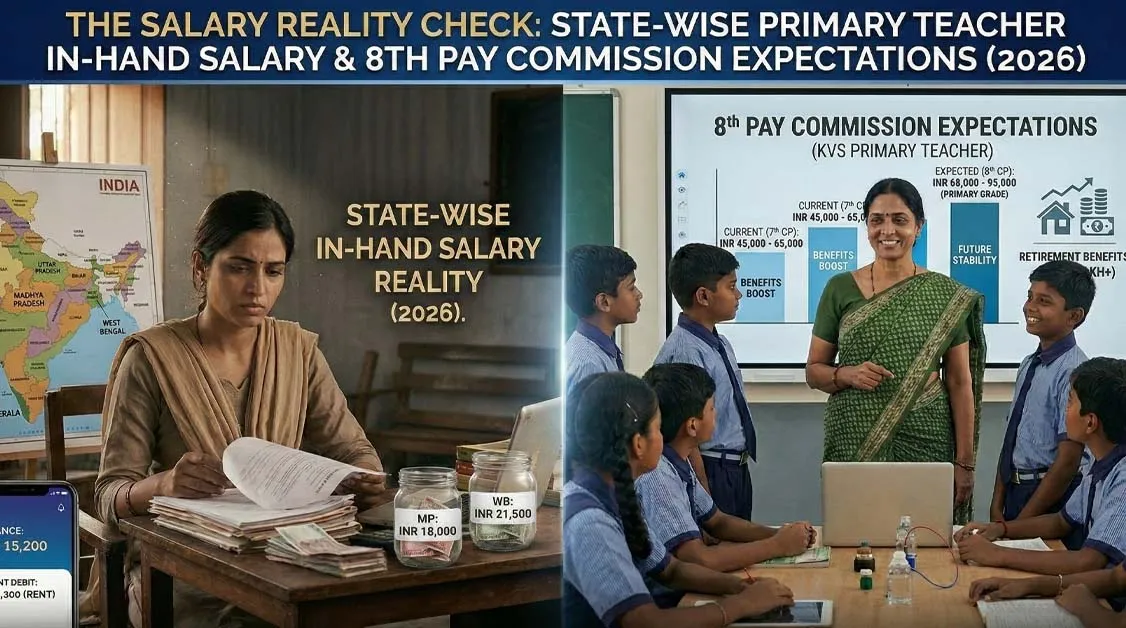
Every year, lakhs of dedicated aspirants spend 10 to 12 hours a day preparing for exams like CTET, DSSSB, UPTET, and REET. They memorize child pedagogy, master mathematics, and undergo rigorous B.Ed or D.El.Ed training. Yet, surprisingly, a massive majority of these aspirants have no clear idea about the actual bank account credit they will receive at the end of their first month of service.
Government job notifications are notoriously complex. They advertise a “Pay Matrix Level 6” or “Basic Pay of ₹35,400,” which leaves candidates utterly confused about their actual In-Hand Salary. Furthermore, the teaching landscape in India is highly fragmented. A Primary Teacher (PRT) in Delhi under DSSSB takes home a drastically different paycheck compared to a teacher clearing the BPSC TRE in Bihar or REET in Rajasthan.
In 2026, with the Dearness Allowance (DA) crossing the historic 50% mark under the 7th Pay Commission, and strong murmurs of the 8th Pay Commission taking shape, the financial dynamics of a government teaching job have changed dramatically.
It is time for a brutal, data-driven reality check. In this guide, we strip away the confusing government jargon to reveal the exact, state-wise in-hand salaries of primary teachers in India, the hidden “probation traps,” and what the upcoming 8th Pay Commission means for your financial future.
Quick Highlights: State-Wise PRT Salary Comparison (2026 Estimates)
| State / Board | Basic Pay (Starting) | Expected Gross Salary | Estimated In-Hand Salary | Probation Rules |
| KVS / DSSSB (Delhi) | ₹35,400 (Level 6) | ₹72,000+ | ₹65,000 – ₹68,000 | Full Pay from Day 1 |
| Uttar Pradesh (Super TET) | ₹35,400 (Level 6) | ₹62,000+ | ₹55,000 – ₹58,000 | Full Pay from Day 1 |
| Bihar (BPSC TRE) | ₹25,000 (New Cadre) | ₹45,000+ | ₹40,000 – ₹42,000 | Full Pay from Day 1 |
| Rajasthan (REET) | ₹23,700 (Fixed) | ₹23,700 | ₹21,000 (For 2 Years) | Reduced Fixed Pay |
The Formula: How is a Primary Teacher’s Salary Calculated?
Before jumping into state-wise differences, you must understand the basic anatomy of a “Sarkari” payslip. The final amount you receive is never just the “Basic Pay” mentioned in the official notification.
Here is how your salary is constructed under the 7th Central Pay Commission (CPC) guidelines, which most states loosely follow:
- Basic Pay: This is the base amount. For most Central and UP state primary teachers, it starts at ₹35,400 (Pay Level 6).
- Dearness Allowance (DA): This is an inflation-busting allowance. As of 2024-2025, DA has crossed 50%. This means you get an additional 50% of your Basic Pay added to your salary.
- House Rent Allowance (HRA): This depends on your posting location. Cities are divided into X, Y, and Z categories. Delhi (X Category) offers up to 27-30% HRA, whereas a rural posting (Z Category) might offer only 9%.
- Deductions: Roughly 10% of your Basic + DA is deducted for the National Pension System (NPS).
State-Wise Salary Reality Check (2026 Ground Data)
The state you choose to teach in dictates your financial freedom. Let us look at the stark differences across major Hindi-belt states and Central bodies.
1. DSSSB (Delhi) & KVS: The Gold Standard
If you want the highest primary teacher salary in India, target Kendriya Vidyalaya Sangathan (KVS) or Delhi Government Schools via DSSSB.
Because Delhi is an “X Category” city, the HRA is massive. Coupled with central DA rates and Transport Allowances (TA), a newly appointed PRT in Delhi takes home roughly ₹65,000 to ₹68,000 per month. This is equivalent to many mid-level corporate IT jobs.
2. Uttar Pradesh (Super TET): The Stable Giant
UP is highly sought after because, unlike neighboring states, it gives you your full salary from the very first month. Starting at a Basic Pay of ₹35,400, adding state DA and rural/urban HRA, a new Assistant Teacher in UP takes home a very respectable ₹55,000 to ₹58,000.
3. Bihar (BPSC TRE): The New Structure
Historically, Bihar hired “Niyojit Shikshak” on low, fixed wages. However, with the new BPSC Teacher Recruitment Exams (TRE), the government has introduced a specific “School Teacher” cadre. The Basic Pay is slightly lower at ₹25,000, but with DA, HRA, and Medical Allowances, the in-hand salary comfortably sits around ₹40,000 to ₹42,000.
4. The Rajasthan (REET) Probation Trap
Rajasthan offers a brutal reality check. Through the REET exam, you might secure a Grade-3 teaching job, but you will not receive the 7th CPC salary immediately. The state enforces a strict 2-year probation period where you are paid a fixed remuneration of around ₹23,700, with no DA or HRA. After mandatory NPS deductions, your in-hand is barely ₹21,000. You only unlock the full ₹50,000+ salary after completing these two years.
Expert Advice / Pro-Tip: Do not let state domicile restrict your career. If you live in Rajasthan or Haryana, you should still invest 80% of your preparation energy into cracking CTET and DSSSB/KVS. Clearing a central exam bypasses state probation traps and secures a Tier-1 city lifestyle and central government health benefits (CGHS) for your family.
8th Pay Commission Expectations: A Massive Hike Ahead?
The Pay Commission in India is traditionally revised every 10 years to adjust government salaries against long-term inflation. With the 7th CPC implemented in 2016, the 8th Pay Commission is due for implementation around **2026.
What does this mean for a teaching aspirant cracking an exam today?
- The Fitment Factor: When a new pay commission arrives, salaries are multiplied by a “Fitment Factor.” While the 7th CPC used a factor of 2.57, employee unions in 2026 are demanding a fitment factor of 1.92 to 2.86 on the new merged basic pay.
- The Basic Pay Jump: If the 8th CPC is implemented smoothly, the entry-level Basic Pay for a Primary Teacher (Level 6) could jump from ₹35,400 to roughly ₹51,000+.
- The New Gross: With a new basic pay, even with DA resetting to 0%, the starting gross salary of a KVS or UP PRT will easily cross the ₹80,000 to ₹85,000 mark.
Securing a government teaching job before the 8th CPC rolls out means you will automatically ride the wave of this massive salary revision without having to reappear for any exams.
Conclusion: Value Your Time and Target Strategically
A government teaching job is no longer a low-paying backup option; it is a highly lucrative career that offers unmatched job security, paid maternity leaves, and pension benefits. However, as the data shows, all teaching jobs are not created equal.
If you are an aspirant in 2026, stop applying blindly. Analyze your financial needs. If you cannot survive on a ₹21,000 stipend for two years, state exams with probation periods might not be for you. Focus aggressively on CTET to unlock central vacancies. The upcoming 8th Pay Commission makes the struggle of late-night studying completely worth it. Lock yourself in, clear the CBT, and secure your financial future.
Frequently Asked Questions (FAQs)
Which state pays the highest salary to primary teachers in India?
Delhi (via DSSSB) and Central Schools (Kendriya Vidyalaya) pay the highest salaries to primary teachers. Due to Central Government DA rates, high Tier-X city House Rent Allowance (HRA), and Transport Allowances, the in-hand salary easily exceeds ₹65,000 per month.
What is the probation period trap in state teaching jobs?
States like Rajasthan and Madhya Pradesh place newly recruited teachers on a 2 to 3-year probation period. During this time, teachers do not receive standard Pay Commission benefits (Basic + DA + HRA). Instead, they are paid a highly reduced, fixed monthly stipend (around ₹21,000 to ₹25,000).
Will the 8th Pay Commission increase teacher salaries?
Yes. The 8th Pay Commission, expected to be discussed and implemented around 2026-2027, will revise the base pay structure. The entry-level basic pay for a Level 6 Primary Teacher is expected to see a significant jump, drastically increasing both gross and in-hand salaries.
Do primary teachers get paid during summer vacations?
Yes. Permanent government primary teachers are entitled to fully paid summer and winter vacations. Unlike private or contractual (ad-hoc) teachers, a regular Sarkari teacher receives their complete salary, including all allowances, while school is closed for the holidays.
What is the difference between Gross Salary and In-Hand Salary?
Gross Salary is the total amount calculated by adding your Basic Pay, DA, HRA, and other allowances. In-Hand Salary (or Net Salary) is the actual amount credited to your bank account after mandatory government deductions, such as the 10% contribution to the National Pension System (NPS) and professional taxes.

HS Patel is a seasoned expert with over 8 years of experience in the field of e.g., Education & Career Counseling. With a deep understanding of industry trends and user needs, he is dedicated to providing accurate, reliable, and high-quality content. His mission is to simplify complex information and empower readers with the right knowledge to succeed.