
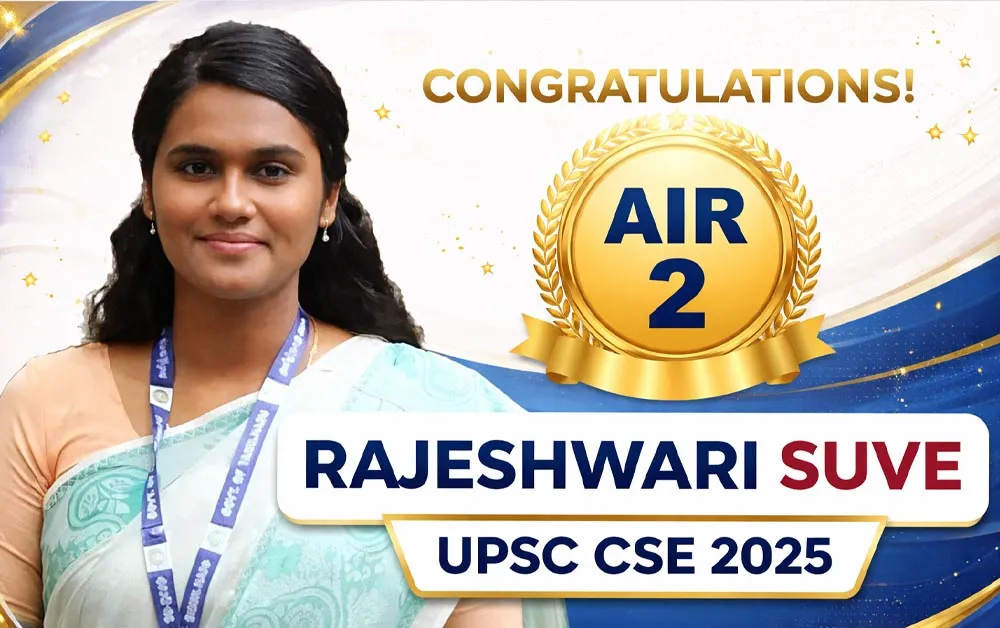
The Union Public Service Commission (UPSC) Civil Services Examination is a marathon that tests not just knowledge, but the very soul of an aspirant. On March 6, 2026, when the final results for the 2025 cycle were announced, one name shone brightly at the top: Rajeshwari Suve M, who secured All India Rank (AIR) 2. Her story is a phenomenal example of how persistence can turn the tide of failure into a historic victory.
Hailing from a small town in Tamil Nadu, Rajeshwari’s journey was anything but easy. Despite the immense pressure and four previous unsuccessful attempts at the Prelims, she refused to give up on her dream. Today, as the nation celebrates her achievement, future aspirants can find a goldmine of insights in her preparation model. In this article, we break down her transition from a state-level Deputy Collector to an IAS officer, her masterclass in Sociology, and the exact questions she faced in the legendary Dholpur House interview room.
The Success Story & Strategy of Rajeshwari Suve (AIR 2)
Background & Journey: The Power of Five Attempts
Rajeshwari Suve M hails from Vadipatti in Madurai district, Tamil Nadu. She comes from a modest yet academically oriented family; her father is a businessman (running a spares shop) and her mother is an Associate Professor. This environment instilled in her a deep respect for education from an early age.
She completed her Bachelor of Engineering (B.E.) in Electrical and Electronics Engineering in 2018 from Vel Tech Multi Tech Engineering College (Anna University). Interestingly, Rajeshwari did not taste success immediately. She appeared for the Preliminary examination five times. In her first four attempts, she could not clear the first stage. However, in her fifth attempt in 2025, she didn’t just clear it—she dominated the entire process to secure the second-highest rank in India.
Preparation Strategy & Daily Routine
What makes Rajeshwari’s success even more remarkable is that she was already serving as a Deputy Collector (Training) in Dindigul, Tamil Nadu, after clearing the TNPSC Group 1 exams. Balancing a high-responsibility government job with UPSC preparation required a surgical daily routine.
- The “Core Four” Hours: Rajeshwari focused on 4 hours of high-intensity study before her office hours and 3 hours late at night. She emphasized quality over the number of hours.
- Sociology Optional: She chose Sociology because of its relevance to administration and her personal interest in societal structures. She practiced “interlinking” current events with sociological theories (e.g., linking the migrant crisis to Durkheim’s theory of Anomie).
- Active Revision: Instead of reading new books every month, she revised her basic notes 15-20 times. She believes that “limited resources lead to maximum retention.”
- The Naan Mudhalvan Edge: She credits the Tamil Nadu government’s Naan Mudhalvan scheme for providing her with the necessary mentorship and financial support during her most critical preparation months.
Recommended Books & Study Material
Rajeshwari followed a strictly minimalist booklist to avoid “information overload.” Here are the standard resources she recommends:
- History: Modern India by Spectrum (Rajiv Ahir) and Ancient India by RS Sharma.
- Polity: Indian Polity by M. Laxmikanth (Read cover to cover multiple times).
- Economics: Mrunal Patel’s notes and the latest Economic Survey.
- Geography: NCERTs (Class 6-12) and the Orient Blackswan Atlas.
- Environment: Shankar IAS notes and daily updates from The Hindu.
- Sociology Optional: Haralambos and Holborn (Blue/Orange book) and Essential Sociology by Nitin Sangwan.
The Interview Experience / Personality Test
The UPSC Personality Test is where candidates are judged on their “administrative officer qualities.” For Rajeshwari, this stage was about proving that her existing experience as a Deputy Collector made her the perfect fit for the IAS.
The Panel & Atmosphere
Rajeshwari’s interview was conducted by a board known for its analytical and “DAF-centric” approach. She described the environment as highly cordial but intellectually demanding. The board didn’t try to “trap” her; instead, they engaged in a deep dialogue about Tamil Nadu’s governance models and her professional ethics.
Types of Questions Asked
The questions were a mix of her professional background, her engineering roots, and her optional subject.
- The Service Transition: “You are already a Deputy Collector. Why do you want to move to the IAS? Isn’t state service enough to serve the people?” * Her Approach: She highlighted the pan-India perspective and the opportunity to work on diverse policy frameworks that only the IAS offers.
- DAF-Based (Madurai): Questions were asked about the Chithirai Festival and how she would manage the massive crowds as a District Magistrate using technology.
- Electrical Engineering: Since she is an EEE graduate, they asked: “How can India achieve its 500 GW non-fossil energy target by 2030, and what are the hurdles in the Green Energy Corridor?”
- Sociology & Current Affairs: “How has the ‘digital divide’ changed the caste dynamics in rural India?” This allowed her to showcase her theoretical depth combined with real-world observations from her training.
The Winning Approach
Rajeshwari maintained a composed and smiling demeanor throughout the 30-minute session. When she faced a highly technical question about the specific “Smart Grid” protocols which she couldn’t recall, she simply said: “I am unable to recall the specific protocol right now, but I can tell you about the general framework if permitted.” This showed her honesty and refusal to “bluff” the board.
Result Analysis & Competition
The UPSC 2025 results show a fascinating trend: the rise of working professionals. Out of the 9,37,876 applicants, only 958 candidates were recommended.
The cut-off for the General category in Prelims was approximately 92-94, and the total marks for AIR 2 Rajeshwari Suve are expected to be significantly high in the Interview stage (Personality Test), likely in the 190-205 range. Her success underscores that even if you miss the Prelims four times, a single breakthrough year can take you straight to the top.
Roadmap for Future Aspirants
If you are starting your journey today, follow Rajeshwari’s “Victory Roadmap”:
- Don’t Fear Failure: Clearing the exam on the 5th attempt after 4 Prelims failures proves that “Attempts don’t define you, your last result does.”
- Focus on Sociology (or your Optional): Spend 3-4 months mastering your optional before the Prelims notification. It is the real “Rank Booster.”
- Daily Answer Writing: Don’t wait to “complete the syllabus” to start writing. Write one answer daily based on the editorial of The Hindu.
- Mock Test Analysis: Don’t just give tests. Analyze why you got a question wrong—was it a lack of knowledge or a silly mistake?
Frequently Asked Questions (FAQs)
Q1. Who is the UPSC 2025 AIR 2 topper?
Ms. Rajeshwari Suve M, an engineering graduate and a trainee Deputy Collector from Madurai, Tamil Nadu, secured AIR 2.
Q2. What was Rajeshwari Suve’s optional subject?
She chose Sociology as her optional subject, which helped her gain a deep understanding of societal issues and governance.
Q3. How many attempts did Rajeshwari take to clear UPSC?
This was her fifth attempt. She had not cleared the Preliminary stage in her previous four attempts.
Q4. Which coaching institute did Rajeshwari Suve join?
She utilized various resources, including the Interview Guidance Program at NEXT IAS and support from the Naan Mudhalvan government scheme.
Q5. What is the educational background of AIR 2 Rajeshwari?
She holds a B.E. in Electrical and Electronics Engineering from Anna University (2018).

HS Patel is a seasoned expert with over 8 years of experience in the field of e.g., Education & Career Counseling. With a deep understanding of industry trends and user needs, he is dedicated to providing accurate, reliable, and high-quality content. His mission is to simplify complex information and empower readers with the right knowledge to succeed.