
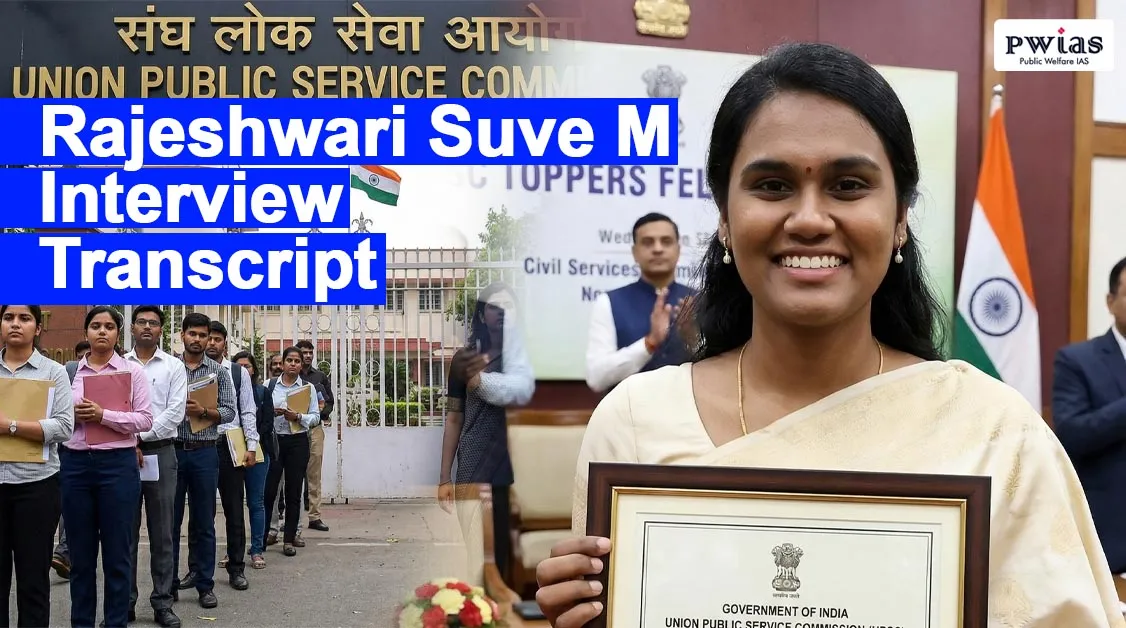
The UPSC Personality Test is the ultimate filter where a candidate’s mental caliber, integrity, and administrative potential are scrutinized. For Rajeshwari Suve M, who secured All India Rank (AIR) 2 in the 2025 Civil Services Examination, the interview was a test of “upgrading”—moving from the mindset of a state administrator to a national policy visionary.
Having already served as a Deputy Collector (Training) in Dindigul, Tamil Nadu, Rajeshwari entered the interview room with a rare blend of field experience and academic rigor. Below is a reconstructed transcript based on her interview experiences, her engineering and sociology background, and the key themes that defined her 202/275 scoring performance.
UPSC Interview Transcript Rajeshwari Suve M (AIR 2)
Board Chairperson: [Welcoming with a warm smile] “Good afternoon, Rajeshwari. Please be seated. You are already a Deputy Collector in Tamil Nadu, and you’ve topped the state PSC. It’s a prestigious role. Why the urge to shift to the IAS? Is there something you can’t achieve for the people of Madurai or Dindigul in your current role?”
Rajeshwari Suve M: “Thank you, sir. While the state service offers an incredible platform for grassroots impact, the IAS provides a pan-India perspective and the opportunity to work on diverse policy frameworks—from international trade to national security—that aren’t available at the state level. I view this not as leaving my state, but as taking the ‘Dravidian Model’ of inclusive growth to the national stage while learning from other states’ best practices.”
Member 1: Regional Governance & Tamil Nadu Politics
Member 1: “Tamil Nadu is often cited for its high social indicators. However, there is a unique intersection of Cinema and Politics in your state. Does this celebrity-driven politics help in governance, or is it just a populist distraction?”
Rajeshwari Suve M: “Sir, the cinema-politics nexus in Tamil Nadu is rooted in the Social Reform movements. Icons like MGR used cinema to disseminate social messages before entering administration. While there is a risk of populism, it has historically helped in mass mobilization for healthcare and education schemes. The challenge for an administrator is to ensure that the ‘charisma’ of the leader translates into ‘institutionalized’ welfare rather than just symbolic gestures.”
Member 1: “Tamil Nadu has a long-standing opposition to the Three-Language Policy. As a potential IAS officer, how would you balance federal mandates with strong regional linguistic sentiments?”
Rajeshwari Suve M: “Ma’am, language is not just a tool for communication but a vehicle for culture. I believe in ‘Functional Bilingualism’ where the local language and English serve as bridges to global and state opportunities. As an officer, I would advocate for the spirit of the NEP while respecting the Two-Language Policy that has successfully driven Tamil Nadu’s high literacy and industrial growth.”
Member 2: Sociology & Social Stratification
Member 2: “You have opted for Sociology. There is a heated debate about implementing a ‘Creamy Layer’ for SC/ST categories, similar to the OBCs. Given your administrative experience, do you think this would promote social justice or dilute it?”
Rajeshwari Suve M: “Sir, from a sociological lens, reservation is a tool for representation, not just poverty alleviation. While the creamy layer helps in horizontal distribution of benefits among the OBCs, implementing it for SC/STs is complex because the stigma of untouchability often persists regardless of economic status. However, as an administrator, if the data suggests that only a few families are monopolizing benefits across generations, a nuanced ‘sub-categorization’ could be a better middle path than a blunt creamy layer filter.”
Member 3: Electrical Engineering & Energy Security
Member 3: “You are an Electrical and Electronics Engineer. India is pushing for a 500 GW renewable target. But our DISCOMs are in a ‘death spiral’ of debt. How would you fix the leakages as a District Magistrate?”
Rajeshwari Suve M: “Sir, the leakage is both technical and commercial. I would focus on ‘Smart Metering’ to eliminate human error in billing and use the ‘PM-KUSUM’ scheme to solarize agricultural pumps. This would reduce the subsidy burden on the state government and make the power grid more resilient at the local level.”
Member 4: Situational & International Relations
Member 4: “Rajeshwari, if you are posted as an officer in a district facing a severe water crisis (like the Cauvery delta issues), and there are protests against a neighboring state, how do you manage the law and order while ensuring the farmers get water?”
Rajeshwari Suve M: “Sir, my first priority would be De-escalation through Communication. I would set up a ‘District Water Budgeting’ committee involving farmer representatives to show them the transparent data of available water. Simultaneously, I would promote ‘Micro-irrigation’ and desilting of traditional tanks (Eris) under MGNREGA to ensure that we are not just fighting over shared water, but maximizing what we already have.”
The Winning Approach Why She Scored 202/275
Rajeshwari’s high score was a result of her “Field-to-Theory” integration. She didn’t just quote textbooks; she quoted her experiences from Dindigul.
- Dignified Composure: Despite five attempts and four initial failures at the Prelims, she showed no signs of “aspirant fatigue.” Her smile and confidence remained unshaken.
- Balanced Regionalism: She defended her state’s policies (like the Two-Language formula) with logic and data, rather than emotion, showing the board she was ready for a national role.
- Technical Integrity: When asked about complex engineering protocols she couldn’t recall, she admitted it immediately. The board values intellectual honesty over a “know-it-all” attitude.
Frequently Asked Questions (FAQs)
Q1. What was the most unique question asked to Rajeshwari Suve?
The board focused heavily on the cinema-politics link in Tamil Nadu and her transition from a state Deputy Collector to a national IAS officer.
Q2. How did she handle questions on Tamil Nadu’s water crisis?
She used a “Water Budgeting” approach, suggesting technical solutions like desilting and micro-irrigation instead of purely political ones.
Q3. What was Rajeshwari Suve’s interview score?
She secured a stellar 202 out of 275 marks, which is among the highest in the 2025 batch.
Q4. Did she use her Engineering background in the interview?
Yes, she effectively answered questions on Renewable Energy and the “Green Energy Corridor,” linking them to the economic health of DISCOMs.
Q5. What was her strategy for tricky situational questions?
She relied on the “Transparency + Technology” formula, emphasizing that most public protests can be handled by providing honest data to the stakeholders.

I am Reena Sharma, a dedicated educator and mentor at PWIAS (Public Welfare IAS), where my mission is to simplify the journey to the civil services for aspirants across India. With a deep-rooted passion for public service and academic excellence, I specialize in crafting high-impact educational content and strategic roadmaps for UPSC and State PSC candidates.