
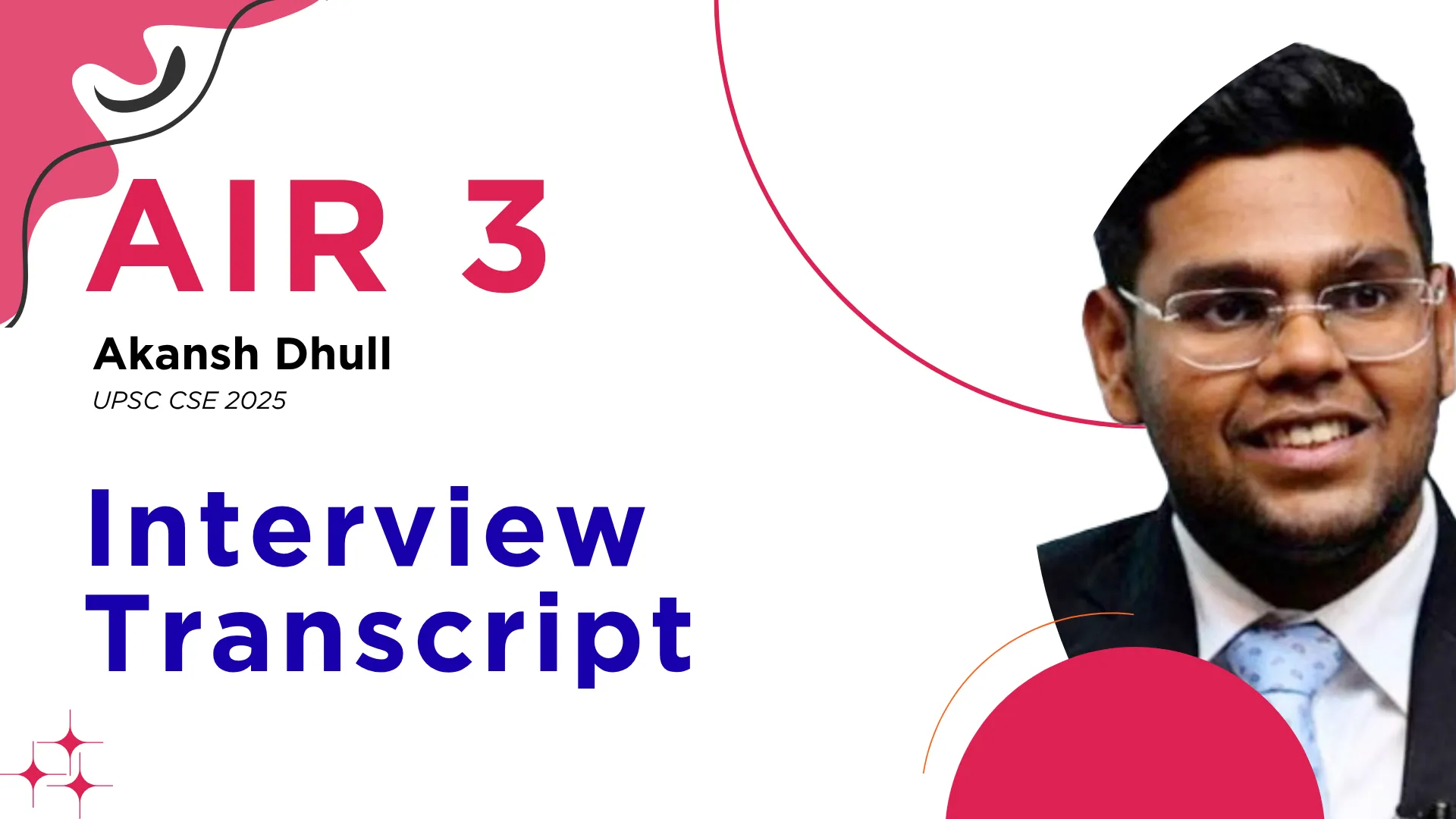
The Personality Test for the UPSC Civil Services Examination is renowned for testing not just what a candidate knows, but who they are. For Akansh Dhull (AIR 3), the interview was the turning point of his 2025 campaign. After scoring 140 in his previous attempt, Akansh completely overhauled his approach, leveraging his Commerce background and demonstrating immense composure to secure a massive 193 out of 275 marks.
Below is a reconstructed transcript based on Akansh’s Detailed Application Form (DAF), his academic background at Shri Ram College of Commerce (SRCC), and his native roots in Haryana.
UPSC Interview Transcript: Akansh Dhull (AIR 3)
Board Chairperson: [Reviewing the DAF] “Welcome, Akansh. I see a very interesting progression here. You are a graduate of SRCC, an institution known for producing top corporate leaders and investment bankers. You had a 10/10 CGPA. Yet, you skipped campus placements entirely to sit for the UPSC, and this is your fourth attempt. Tell me, is this an obsession with power, or did you simply not want to work in the private sector?”
Akansh Dhull: “Thank you, sir. It is neither an obsession with power nor an aversion to the private sector. During my time at SRCC, I realized that while corporate roles offer excellent financial rewards and efficiency, their primary fiduciary duty is to shareholders. My inclination has always been toward maximizing ‘social equity.’ The Civil Services offer a canvas where my decisions can directly impact the most vulnerable sections of society. I viewed the initial setbacks not as failures, but as the necessary gestation period to prepare for this responsibility.”
Member 1: Core Economics & Commerce
Member 1: “Since you are so well-versed in Commerce, let’s talk about the national balance sheet. The government is pushing heavily for Capital Expenditure (Capex), yet we have a strict Fiscal Deficit target of 4.5% to meet. How can a government spend heavily on infrastructure without borrowing recklessly?”
Akansh Dhull: “Sir, the key lies in the ‘multiplier effect’ of Capex and diversifying revenue streams. To balance heavy infrastructure spending with fiscal consolidation, the government can rely on three pillars: First, improving tax buoyancy through formalization and GST rationalization. Second, executing the National Monetization Pipeline (NMP) effectively to unlock value from brownfield assets. And third, rationalizing unproductive revenue expenditures, such as poorly targeted subsidies, and redirecting those funds to capital creation.”
Member 1: “You mentioned the National Monetization Pipeline. The opposition often calls it ‘selling off the country’s assets.’ As an administrator, how do you communicate the difference between privatization and monetization to the public?”
Akansh Dhull: “Sir, the distinction is fundamentally about ownership. I would communicate that in privatization, we transfer both ownership and control permanently. In monetization, the government retains the ownership of the asset; we are simply leasing the ‘revenue rights’ for a fixed period to private players to bring in operational efficiency. We are not selling the house; we are renting it out to build a second house.”
Member 2: Home State Dynamics (Haryana)
Member 2: “Akansh, you belong to Haryana. Your state presents a unique paradox. It has a high per capita income, it contributes heavily to our defense forces, and it produces Olympic medalists. Yet, recent data shows it also has one of the highest youth unemployment rates in the country. How do you explain this paradox?”
Akansh Dhull: “Ma’am, the paradox stems from a structural transition in Haryana’s economy. While agriculture was highly successful during the Green Revolution, it is no longer absorbing the growing workforce. Simultaneously, the industrial hubs like Gurugram and Faridabad are highly service-sector driven (IT/BPO) or capital-intensive manufacturing, which require specific skill sets. The local youth, particularly from rural areas, face a skills mismatch. They are educated, but not necessarily ’employable’ for these modern sectors. We need to pivot from generic degrees to high-quality vocational and technical training to bridge this gap.”
Member 3: Situational & Ethics
Member 3: “Suppose you are the District Magistrate of a district where a major corporate house is setting up a much-needed manufacturing plant. It will bring 10,000 jobs. However, local environmental NGOs have found that the plant might pollute a river that is the lifeline for a tribal community downstream. The Chief Minister’s office wants the project cleared quickly. What do you do?”
Akansh Dhull: “Sir, as a civil servant, my commitment is to the rule of law and sustainable development. I cannot clear a project that violates environmental norms, regardless of the pressure. My first step would be to commission an independent, expedited Environmental Impact Assessment (EIA). If the pollution threat is real, I will initiate a dialogue with the corporate house to mandate the installation of a Zero Liquid Discharge (ZLD) system. This way, we do not lose the 10,000 jobs, but we also ensure the tribal community’s right to life and clean water is strictly protected. Development and environment are not zero-sum games if technology is applied correctly.”
Member 4: The “Stumper” Question
Member 4: “Akansh, there has been a lot of debate recently about the ‘Tobin Tax’ in international finance. Can you explain its relevance to the current fluctuations in the Indian Rupee?”
Akansh Dhull: [Takes a 5-second pause, maintains eye contact] “Sir, I am familiar with the fundamental concept of the Tobin Tax—that it is a tax levied on short-term currency transactions to penalize speculative trading and reduce market volatility. However, I am not completely updated on the specific academic debates regarding its immediate application to the recent fluctuations of the Indian Rupee. I will certainly read more about its contemporary relevance after this interview.”
Board Chairperson: “That is perfectly fine, Akansh. Thank you. Your interview is over. You may leave.”
Akansh Dhull: “Thank you, Sir. Thank you, panel members.” [Nods respectfully and exits]
Post-Interview Analysis: The Winning Elements
Akansh Dhull’s 193-mark performance is a textbook example of how to handle the UPSC board:
- Defending the Gap Years: He did not apologize for his four attempts or his decision to skip corporate placements. He framed it as a conscious, mature choice driven by public service values.
- Leveraging the Optional: His answers on the Fiscal Deficit and Asset Monetization were crisp, technical, yet easy to understand—proving he possessed both academic depth and administrative clarity.
- Handling State Issues Objectively: When asked about Haryana’s unemployment, he avoided political blame games and instead provided a purely structural, economic analysis (the “skills mismatch”).
- The Art of Saying “I Don’t Know”: When faced with the Tobin Tax question, he didn’t bluff. He stated the basic definition he knew and politely admitted his lack of deeper current knowledge, demonstrating the intellectual honesty that UPSC highly rewards.

HS Patel is a seasoned expert with over 8 years of experience in the field of e.g., Education & Career Counseling. With a deep understanding of industry trends and user needs, he is dedicated to providing accurate, reliable, and high-quality content. His mission is to simplify complex information and empower readers with the right knowledge to succeed.